

It was excellent earnings for TSMC and an excellent start for CoreValue Research [see TSMC 4Q25 Preview]!
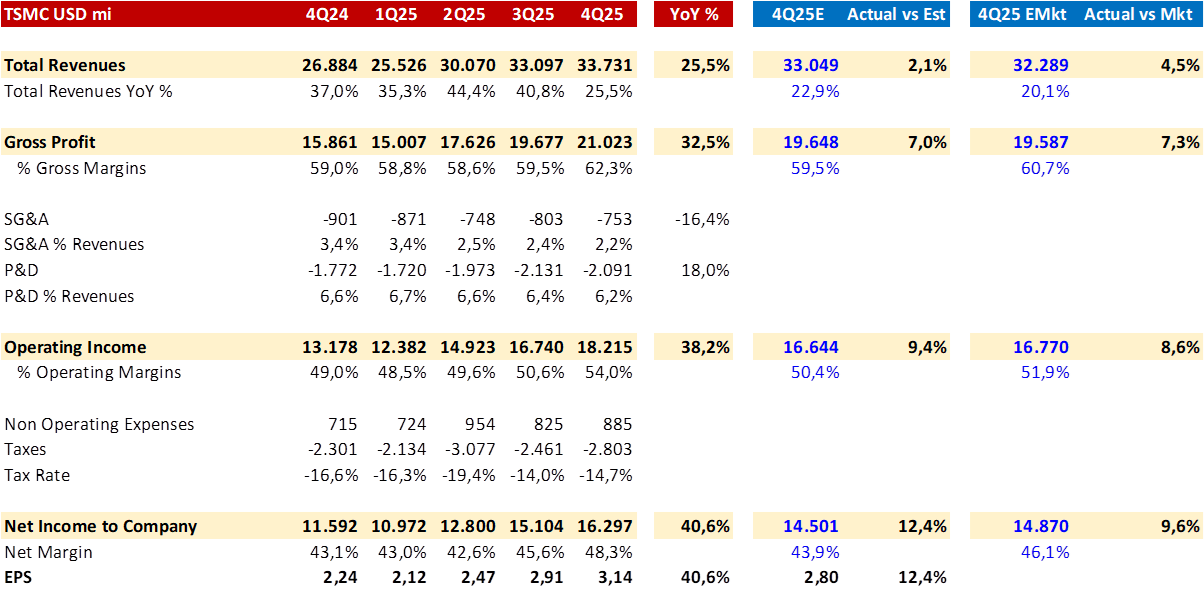
- TSMC delivered strong Revenues in 4Q25, with 25,5% growth (the revenues was already anticipated after Jan release of Dec Revenues [see our Dec Revenues Note], but we kept prior estimates in table to show that it was a strong upside from what market was thinking mid 4Q25!).

- Gross Margins came at 62,3%, exceeding high end of the guidance in 130bps and above our estimates! This was driven by cost improvements, favorable FX rates, and high utilization.

- Operating Margins increased to 54%, up 3.4 percentage points sequentially due to operating leverage.

- EPS of USD 3,14, +40,6% YoY%! It came 12,4% above our expectations.
- ROE of 38.8%.

*1Q26 TSMC Guidance

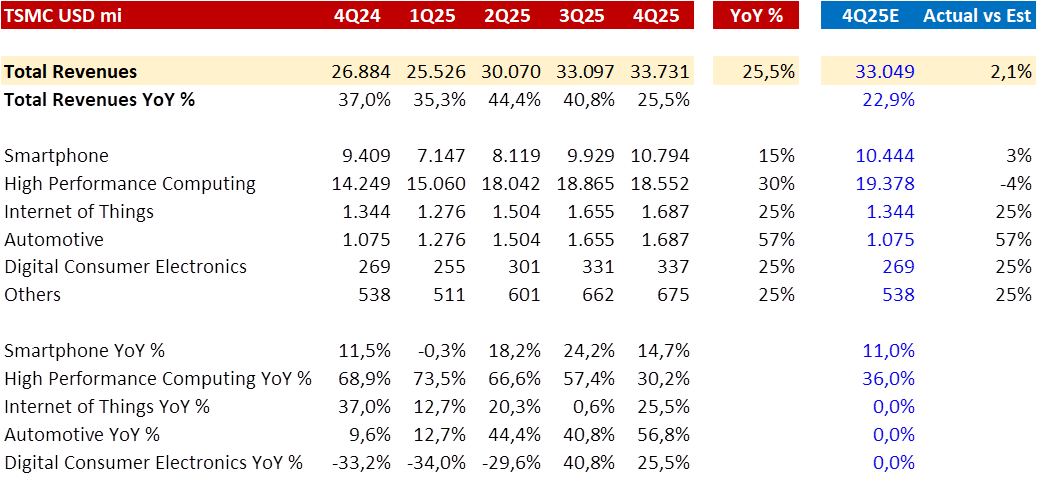
- Technology Mix: Advanced technologies (7nm and below) accounted for 77% of wafer revenue.


- Platform Mix: High Performance Computing (HPC) remains the dominant driver, accounting for 55% of revenue. Smartphone accounted for 32%.


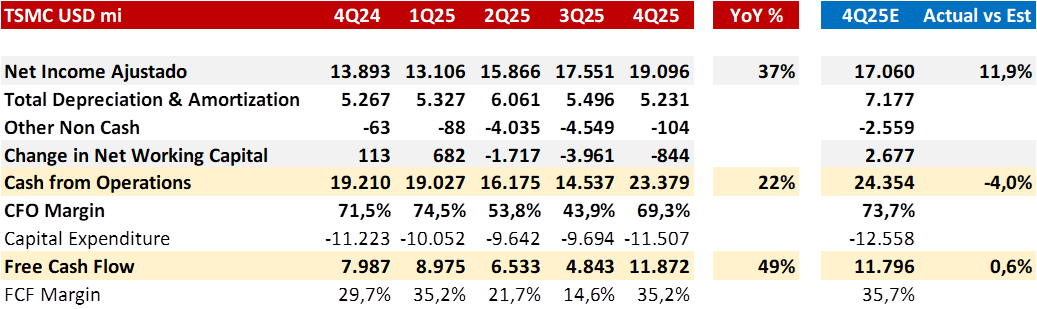
- Cash Flow: Net Income came 12% better than expected, but Depreciation and Working Capital came below our expectations. Cash Flow from Operations came at USD 23,4 bi up +22%.
- TSMC Capex for 4Q25 came USD 1 bi lower than our estimates, but the main information from the call was the Capex expectation of USD 52 bi to USD 56 bi in 2026 and probably will growth further to top USD 200 bi in the next 3 years!
TSMC 4Q25 Conference Call
The central theme of the call was the “insatiable” demand for AI-related technologies, prompting the company to significantly raise its capital expenditure guidance for 2026 to between USD 52 billion and USD 56 billion. Management expressed high conviction in the AI megatrend, validated by direct interactions with hyperscalers, and raised their long-term revenue CAGR forecast to nearly 25%.
1. Financial Performance: Q4 2025 & Full Year 2025
Q4 2025 Results
- Revenue: Reached USD 33.7 billion, a 1.9% sequential increase and almost 3% above guidance (expected -1% sequentially).
- Gross Margin: Came in at 62.3%, exceeding the high end of guidance by 130 basis points.
- Operating Margins: increased to 54%, up 3.4 percentage points sequentially due to operating leverage.
- EPS of USD 3,14, ROE of 38.8%.
Full Year 2025 Recap
- Revenue Growth: Increased 35.9% YoY in USD terms, outperforming the general foundry industry.
- Platform Growth: HPC revenue grew 48% YoY, accounting for 58% of total 2025 revenue.
- Dividends: Shareholders received TWD 18 per share in 2025, expected to rise to at least TWD 23 per share in 2026.
2. Guidance & Outlook: 2026
Q1 2026 Guidance
- Revenue: Expected between USD 34.6 billion and USD 35.8 billion (approx. +38% YoY).
- Gross Margin: Forecasted at 63% – 65%. [It’s an incredible level for GM, but N2 and Arizona ramp up may dilute from here!]
- Operating Margin: Forecasted at 54% – 56%.
Full Year 2026 Outlook
- Revenue Growth: Forecast to increase by close to 30% in USD terms. [This was right in line with our call and we believe the market will revise up!]
- Industry Context: The “Foundry 2.0” industry is expected to grow 14%, meaning TSMC expects to significantly outperform the market.
- Tax Rate: Expected to increase to 17% – 18%.
- Headwinds: Gross margin dilution from overseas fabs is expected to be 2-3% (early stage) and ramp of 2-nanometer (N2) technology will dilute margins by another 2-3% in 2H 2026.
3. Strategic Deep Dive & Operational Updates
A. The AI Megatrend & Demand
- Conviction: CEO C.C. Wei stated that AI demand is “real” and “fundamental”. He personally validated this with cloud service providers (CSPs) who confirmed AI is driving financial returns for them.
- Updated Forecasts:
- AI Accelerator Revenue: CAGR raised to “mid- to high 50s percent” for the 2024–2029 period.
- Corporate Revenue: Long-term revenue CAGR raised to approach 25% (2024–2029). [This is exactly in line with our models, which reinforced our conviction in the case]
- Supply Bottleneck: The constraint on AI growth is currently silicon supply from TSMC, not power availability.
B. Massive Capital Expenditure (CapEx) Increase
- 2026 Budget: CapEx is guided to USD 52 billion – USD 56 billion. This is a significant jump from USD 40.9 billion in 2025 and USD 29.8 billion in 2024.
- Allocation: 70-80% for advanced process technologies; 10-20% for advanced packaging/mask making; 10% for specialty technologies.
- Rationale: The increase is strictly to support customer growth. Building new fabs takes 2-3 years, so 2026 CapEx is preparing for supply in 2028/2029.
[See “The Bad” Session in Our Preview Article!]
C. Technology Roadmap (N2, A16)
- N2 Status: Entered high-volume manufacturing in Q4 2025 with good yield. It is expected to ramp fast in 2026.
- N2P & A16: N2P volume production is scheduled for 2H 2026. A16 (featuring Super Power Rail) is also on track for volume production in 2H 2026.
- Adoption: N2 is seeing wider adoption than previous nodes, driven by the need for energy efficiency in both smartphone and HPC.
D. Global Footprint Updates
- Arizona (USA):
- Fab 1: Entered high-volume production in Q4 2024.
- Fab 2: Schedule pulled forward due to strong customer demand; volume production now expected in 2H 2027.
- Fab 3: Construction started.
- Expansion: TSMC purchased a second large piece of land to support an independent “giga-fab cluster”.
- Japan: Kumamoto specialty fab started volume production in late 2024. Fab 2 construction has started.
- Europe (Germany): Construction is progressing according to plan.
Q&A Analysis
On AI Sustainability and “Bubble” Concerns: Is there an AI bubble? How real is the demand?
- C.C. Wei admitted nervousness about the massive USD 52-56B investment but confirmed demand is real after auditing customers’ financials and applications. AI is now integrated into daily life (e.g., social media algorithms).
On Supply Constraints & Bottlenecks: Will supply/demand balance in 2027? Is power a constraint?
- Power: Customers (CSPs) planned for power 5-6 years ago; they tell TSMC that silicon is the bottleneck, not electricity.
- Supply Gap: Capacity remains very tight. 2026/2027 output growth relies on productivity improvements because new fabs take years to build. The massive 2026 CapEx will mostly address supply in 2028/2029.
On Competition (Intel/IDMs): Are you worried about U.S. foundry competition (Intel) given government support?
- No. C.C. Wei noted that money alone doesn’t build competitiveness. The complexity of technology means customers need 2-3 years to design and another 1-2 years to ramp, making it difficult for competitors to catch up quickly.
On Pricing and Margins: Is a 20% wafer ASP increase the “new normal”?
- Pricing is strategic to earn value. While blended ASP increases with new nodes, profitability is driven by six factors, primarily utilization and manufacturing excellence (productivity), not just price hikes. Long-term gross margin of 56%+ is achievable.
On Mature Nodes & Legacy Business: Rumors of TSMC exiting 8-inch/mature nodes?
- TSMC is not exiting the business. They are reducing some 6-inch/8-inch capacity and optimizing resources but will continue to support customers in these nodes.
On Non-AI Demand (Smartphones/PC): Impact of rising memory prices on smartphone/PC demand?
- TSMC sees “no impact.” Their exposure is primarily to high-end smartphones which are less price-sensitive. Unit growth in these sectors may be minimal, but silicon content and premium demand remain healthy.
On Advanced Packaging: What is the focus of packaging CapEx?
- Advanced packaging revenue contribution was ~8% in 2025 and will be slightly over 10% in 2026. It is growing faster than the corporate average. CapEx for packaging (plus mask making/others) has risen to 10-20% of the total budget.
Thank you,
CoreValue Research

