

An Outstanding Quarter for a Long Term Compounder!
Amazon reported a very strong second quarter, led by accelerating AWS growth, expanding cloud profitability, healthy commerce activity, and continued advertising momentum.
The central message of the call was that Amazon believes it is entering a major AI-driven investment cycle: near-term capital expenditure and free-cash-flow pressure will be substantial, but management sees unusually strong contracted demand, attractive server economics, long-lived data-center assets, and the potential for AWS eventually to become a business with as much as $1 trillion in annual revenue.
Management’s argument also maintained that AI consumption stimulates Amazon’s traditional cloud infrastructure business because AI applications require CPUs, storage, databases, security, networking, and access to customers’ existing applications and data.
In this framing, AI and “core” AWS are mutually reinforcing rather than separate growth engines.
1. Headline financial performance

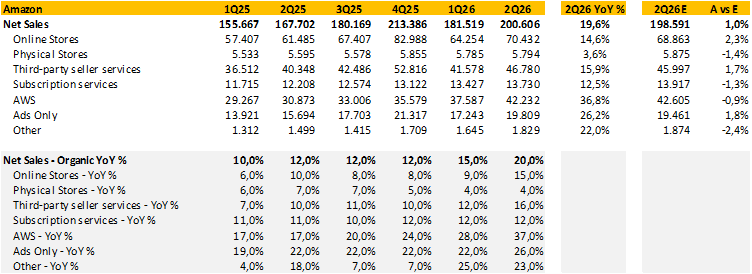
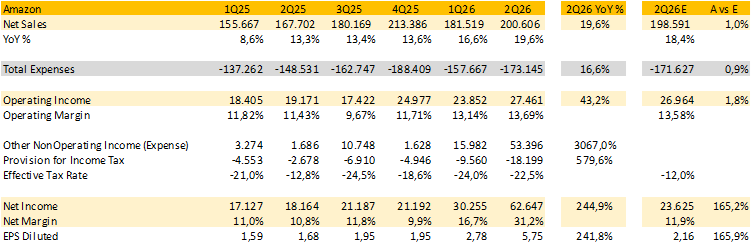
Amazon generated:
MetricQ2 2026 result Year-over-year change
- Worldwide revenue $200.6 billion +20% YoY %, excluding FX
- Operating income $27.5 billion +43% YoY %
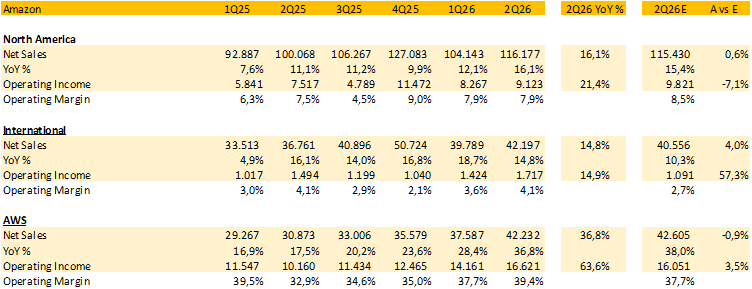
- North America revenue $116.2 billion +16% YoY %
- International revenue $42.2 billion +15%, excluding FX
- AWS revenue $42.2 billion+36.7%
- Advertising revenue$19.8 billion +26%
- Worldwide paid units +17%
- Cash capital expenditure$53.1 billion
The reported operating result included approximately $1.2 billion of favourable items:
- Approximately $600 million of tariff-related refunds, recorded in North America.
- Approximately $600 million from a change in the fair-value measurement of energy contracts subject to derivative accounting, primarily benefiting AWS.
These benefits are important when assessing underlying profitability. The AWS operating margin was approximately 39%, with operating income of $16.6 billion.
Brian Olsavsky said the margin expanded 650 basis points year over year on a reported basis, but approximately 520 basis points excluding the derivative-accounting gain.
Amazon therefore delivered significant underlying AWS margin expansion even after removing the unusual benefit, although management repeatedly cautioned that AWS margins can fluctuate with investment levels, capacity utilization, product mix, and the balance between AI and non-AI workloads.
2. AWS was the centerpiece of the quarter

AWS revenue increased 36.7%, marking its fifth consecutive quarter of acceleration and its fastest growth in 18 quarters. This acceleration occurred despite AWS being more than twice the size it was during the earlier comparable growth period.
AWS added more than $4.6 billion of revenue sequentially, approximately 80% more than its previous largest quarterly increase. Its annualized revenue run rate reached approximately $169 billion.
Amazon also reported an AWS backlog of $496 billion, growing at a triple-digit year-over-year rate. The call later characterized this backlog—or RPO—as approximately 2.5 times the level reported in Q3 2025.
Management attributed the acceleration to several connected factors:
- Rapidly expanding AI demand.
- Continued growth in traditional AWS infrastructure.
- Accelerating enterprise migrations from on-premises systems to the cloud.
- Customers locating inference near their existing applications and proprietary data.
- AWS’s perceived advantages in functionality, security, operational performance, databases, storage, and custom silicon.
- New capacity coming online, although management emphasized that capacity alone did not explain the acceleration.
Andy Jassy said approximately 85% of global IT expenditure remains on premises and expects that balance to reverse over the next 10–20 years. In Amazon’s view, the conventional cloud migration opportunity therefore remains very large even before accounting for AI.
The interaction between AI and core cloud services
One of management’s most important explanations was that AI expenditure creates demand outside GPU or accelerator infrastructure.
According to Jassy:
- Post-training and reinforcement learning rely heavily on CPUs.
- Agentic tool use is also largely executed on CPUs.
- AI data must be stored.
- Applications require vector databases and other database capabilities.
- AI inference increasingly needs to operate near companies’ existing applications and data.
Amazon therefore believes AI growth pulls the core AWS business along with it. This is strategically significant because AWS is positioned across the infrastructure stack rather than only in AI accelerators.
Amazon particularly emphasized Graviton, its proprietary CPU family. Management claimed Graviton offers approximately 30%–40% better price performance than alternative CPU options and is used by 98% of AWS’s top 1,000 EC2 customers.
Graviton revenue commitments nearly tripled quarter over quarter, while Graviton5 was reportedly growing almost twice as fast as Graviton4 did at the corresponding stage.
AWS margins and sustainability

AWS operating income reached $16.6 billion, implying an operating margin of approximately 39%.
When asked whether AI workloads would structurally carry lower margins, management responded that:
- AWS profitability was supported by disciplined efficiency improvements.
- Capacity optimization contributed meaningfully during Q2.
- Amazon continued to manage fixed costs closely.
- Custom silicon and networking equipment improved infrastructure efficiency.
- AI margins were following the historical trajectory of core AWS and were slightly ahead of it.
Management nevertheless declined to present the Q2 margin as a permanent run rate. Margins will continue to vary with capacity, investment timing, service mix, and the proportion of AI and non-AI workloads.
The balanced interpretation from the call is therefore that Q2 profitability was not merely an accounting accident—underlying expansion remained strong—but neither should the reported 39% margin automatically be extrapolated without considering quarterly variability.
3. Amazon’s AI stack and product strategy
Management presented AWS as offering a complete AI stack rather than a single model or infrastructure product.

SageMaker AI
Amazon expects technically capable companies to build smaller, proprietary-data-based foundation models, though not necessarily the largest frontier models. SageMaker AI is intended to make that model-building process easier.
Amazon Bedrock
Bedrock provides access to multiple leading models for inference, combined with performance, governance, and security controls. Management said customer spending on Bedrock during Q2 exceeded cumulative customer spending across all prior quarters.
Amazon’s strategy is deliberately multi-model. Jassy argued that there will not be “one model to rule the world.” Models from Anthropic, OpenAI, open-model developers, Amazon, and others are expected to alternate in relative performance and suitability.
Accordingly, AWS’s value proposition is to give companies access to a broad selection of models with appropriate price performance, security, and governance.
Bedrock AgentCore
AgentCore addresses the operational infrastructure required to deploy agents in production, including:
- Secure execution environments.
- Memory and contextual continuity.
- Agent identity and permission to act for users.
- Connections to tools and data.
- Monitoring of production activity.
- Deterministic policies controlling permitted actions.
- Payments, allowing agents to conduct transactions.
- Web search for grounding.
- A development harness and integration with Strands.
Management’s explanation was that creating an agent is only one part of the task; assembling the surrounding infrastructure reliably has delayed many production deployments. AgentCore is intended to remove that bottleneck.
Kiro
Kiro is Amazon’s specification-driven coding agent. Management said it was as much as 50% more cost-effective than competing offerings and that usage tripled sequentially.
Amazon Quick
Amazon Quick is positioned as an enterprise AI work companion. It can search, organize, summarize, and automate work across email, calendars, local and cloud files, workflows, and external SaaS platforms such as Slack, Salesforce, Jira, Teams, and ServiceNow.
Amazon added:
- Autonomous background agents configured using natural language.
- A personalized activity feed combining communications, calendars, tasks, and messages.
- Sixteen new integrations, including Adobe, Moody’s, and Snowflake.
Management listed a substantial number of users, including 3M, Allianz, AstraZeneca, BMW, Exxon, FINRA, Intuit, Moody’s, the NBA, the NFL, and Southwest Airlines.
During the Q&A, Jassy explained that Quick originated from Amazon’s own internal needs. Employees first wanted help summarizing documents and conducting research and business intelligence. They subsequently requested integration with email, Slack, and calendars. Amazon then developed those internal capabilities into an external enterprise service.
Does Amazon need its own frontier model?

JPMorgan asked whether Amazon needed a leading proprietary frontier model given Bedrock’s multi-model strategy.
Jassy’s answer had two parts:
- AWS could become highly successful without owning a frontier model because customers will need access to several leading models.
- Nevertheless, Amazon is developing its own frontier model.
The reasons given for developing an Amazon model were:
- Greater control over costs for Amazon’s own consumer applications.
- The ability to reduce customer inference costs.
- Control over which capabilities and use cases receive priority in training.
- Better alignment with the needs of AWS customers and internal Amazon businesses.
- Greater control over development speed.
Jassy expects at least half a dozen broadly comparable leading models to exist within the next few years. He expects all of them to be available through Bedrock, including Amazon’s own model.
The strategic implication within management’s comments is that Amazon does not see its model as replacing Bedrock’s model marketplace. It is intended to complement the multi-model platform while providing Amazon with better control over economics and product priorities.
The “barbell” structure of AI demand
Jassy described present AI adoption as “barbelled.”
At one end are:
- Frontier AI laboratories consuming exceptionally large amounts of compute.
- A small number of highly successful generative-AI applications, such as Claude Code and ChatGPT.
At the other end are enterprises producing measurable value through:
- Customer-service automation.
- Business-process automation.
- Fraud detection.
- Cost avoidance.
- Productivity improvements.
The relatively underdeveloped middle consists of existing enterprise production workloads. Some already use inference extensively, but most do not.
Jassy believes this middle will eventually become the largest segment in absolute terms. AI should alter existing customer experiences and create new applications and businesses that do not yet exist.
This is a central element of Amazon’s demand thesis: the current capacity commitments are arriving before broad-based enterprise inference has become pervasive. Management therefore considers the market to be in an early stage despite the present scale of investment.
4. Custom chips: Trainium and Graviton

Amazon said its combined chip business had exceeded a $25 billion annualized revenue run rate and was growing at a triple-digit rate.
Trainium is Amazon’s AI accelerator, while Graviton is its CPU family. Management believes Amazon offers leading price performance in both categories.
Amazon said Anthropic and OpenAI had made multiyear, multi-gigawatt commitments to Trainium. Additional adopters named on the call included NEURA Robotics, Odyssey, TwelveLabs, Decart, Poolside, Karakuri, Metagenomi, NetoAI, Splash Music, Uber, and Pinterest.
At the same time, Jassy emphasized that Amazon would maintain its deep partnership with NVIDIA. AWS expects some customers to continue using NVIDIA chips for the foreseeable future and sees customer choice as beneficial for competition and for lowering inference costs.
Possible external sale of Trainium
Morgan Stanley asked about selling Trainium chips to customers for use in third-party data centers rather than only through AWS.
Jassy said Amazon was seeing increasing customer interest in acquiring Trainium separately from AWS. Amazon was actively discussing and exploring that possibility, and he believed there was a real chance it would offer Trainium externally in the future.
However, no timing, commercial structure, pricing, or return comparison with AWS-based deployment was provided.
5. Capital expenditure and Amazon’s ROIC argument
Amazon increased its expected 2026 cash capital expenditure from approximately $200 billion to approximately $220 billion. Management attributed the increase primarily to higher memory costs.
Even at that level, Amazon does not expect to have enough capacity to satisfy all demand in 2026. Jassy said this supply constraint would likely continue in 2027, while the amount of demand already visible for 2028 was “striking.”
The call offered a detailed defense of this investment.
Data centers
Data-center spending begins approximately two years before servers can be installed and monetization can start. Once operational, however, these facilities can be used for more than 30 years.
Management expects each data center to support at least five or six generations of servers. Later server generations should have better economics because Amazon does not have to repeat the initial data-center investment.
Servers and networking equipment
Servers and networking equipment have a shorter investment cycle. Amazon generally purchases them only a few months before deployment, when it already has substantial visibility into customer demand.
Management said:
- If demand is not present, Amazon will not make the equipment expenditure.
- Server and networking investments generally break even in slightly less than three years.
- Servers currently have useful lives of at least five to six years.
- Most new AI capacity is contracted for at least five years.
- Consequently, Amazon expects two to three years of significant free-cash-flow generation after reaching break-even.
Amazon also believes it has historically shortened equipment break-even periods and extended useful lives without harming customer experience.
Near-term free-cash-flow pressure
Management acknowledged that simultaneous data-center construction creates a substantial near-term mismatch: Amazon spends capital well before the facilities can produce revenue.
Free cash flow will therefore face pressure until:
- Data centers are completed.
- Servers are installed.
- The capacity begins generating revenue.
- Server utilization advances beyond the investment’s break-even period.
Amazon expects the financial profile to improve when revenue growth eventually begins to exceed incremental CapEx growth.
The key claim was that AI margins and returns are developing similarly to those of traditional AWS at an equivalent stage—and are actually somewhat ahead of the historical core-cloud trajectory.
Funding the infrastructure build-out
Olsavsky noted that Amazon had issued debt during the year and retained several financing options. Management would evaluate the alternatives and choose the appropriate source of capital at the appropriate time.
No specific future debt amount, financing mix, leverage target, or capital-raising schedule was disclosed.
Capacity outlook
Amazon remains on track to double its power capacity by the end of 2027 compared with 2025.
When asked whether data-center investment could begin slowing in 2027, Jassy offered no indication of a slowdown. Most of the additional 2027 capacity is already reserved, and meaningful 2028 capacity has also been committed.
The backlog is already incorporated into Amazon’s capital plans. Because management expects additional contracts to be signed, the comments imply that the current investment cycle could continue beyond 2027.
6. Advertising

Advertising revenue increased 26% to $19.8 billion.
Sponsored Products remained the largest offering and a principal growth driver. Amazon is also integrating commercial prompts into its agentic and conversational shopping experiences.
Management said shoppers who clicked sponsored prompts:
- Converted into purchases 48% more frequently.
- Spent 21% more on average.
Prime Video advertising and live sports also contributed. Advertising inventory for Thursday Night Football, the NBA, WNBA, and NASCAR sold out. More than 30 advertisers joined NBA programming during its first year on Prime Video.
Brands advertising across multiple sports achieved 2.3 times greater unduplicated reach than single-sport advertisers. Multisport viewers generated 12% higher spending and 17% more Amazon orders.
Amazon’s Ads Agent automates campaign setup and targeting. Advertisers using its targeting capabilities recorded:
- 8% lower cost per impression.
- 6% lower cost per acquisition.
The product expanded into 11 additional countries during the year.

Alexa, AI-assisted shopping, and entertainment

More than 350 million customers used Alexa for Shopping during the previous 12 months. During Q2:
- Active users nearly doubled year over year.
- Interactions increased more than fivefold.
The assistant provides product recommendations, comparisons, pricing histories, price alerts, and automated purchasing.
In the United States, customers using Alexa for Shopping spent more than 40% more per order than customers who did not. Customers who had tried Alexa+ subscribed to Prime at an almost 25% higher rate.
Alexa+ expanded to Germany, Austria, France, and Brazil.
Amazon Lens, which helps users find products by photographing an object, expanded to 10 more countries and was available in 21 countries.
In entertainment:
- Game 7 of the NBA Eastern Conference Semifinals reached a peak of 6.5 million U.S. viewers.
- European NBA viewership on Prime Video more than doubled.
- The premiere of Off Campus attracted 36 million global viewers during its first 12 days, making it Prime Video’s third-largest series debut.
7. Stores and commerce

Amazon’s North America revenue increased 16% to $116.2 billion, while International revenue increased 15%, excluding FX, to $42.2 billion.
Prime membership grew at a double-digit rate. The company attributed commerce momentum to:
- Additional product selection.
- Competitive prices.
- Faster delivery.
- Prime Day.
- Everyday essentials.
- Grocery and perishables.
- Pharmacy.
- New fulfillment and logistics services.
Amazon added millions of products during the quarter, including more than 700,000 products from notable brands. Amazon Haul’s ultra-low-price selection in the United States expanded almost twentyfold since launch, with more than six million items priced below $10.
Prime Day contributed to Q2 because its timing shifted into the quarter in most of Amazon’s largest markets, including the United States. Management said more than 80% of Prime Day deals offered the lowest price of the year, while hundreds of thousands of products were discounted by 40% or more.
Cost inflation and contract pricing
The higher 2026 CapEx forecast was attributed mainly to higher memory costs. An analyst therefore asked whether long-term AWS agreements protected Amazon’s returns from component inflation.
Jassy explained that:
- Some AWS demand is on-demand and not contractually committed.
- A large portion is governed by agreements with predetermined prices.
- Existing contract pricing remains applicable for the contract’s duration.
- New agreements incorporate Amazon’s current costs into negotiated pricing.
Management acknowledged that memory, hard drives, and SSDs were experiencing inflation. The response suggests that Amazon can reflect higher costs in newly negotiated contracts, but it did not indicate that existing agreements automatically reprice or contain comprehensive inflation protection.


Fulfillment efficiency
Amazon continued working to:
- Position inventory closer to customers.
- Shorten shipping distances.
- Reduce the number of touches per package.
- Improve order consolidation.
- Increase automation and robotics.
It expects to more than double its fleet of Cardinal and Sparrow robotic arms during 2026.
These efficiencies were partially offset by higher transportation costs, including fuel inflation associated with the Middle East conflict and higher line-haul rates caused by driver-capacity limitations.
Excluding fuel and line-haul inflation, shipping costs grew more slowly than worldwide unit volume. The FBA fuel and logistics surcharge introduced in April partially compensated for the additional costs.
Grocery and everyday essentials
Grocery was one of the strongest commerce themes in both the prepared remarks and the final analyst question.
Amazon said its grocery business generated more than $150 billion in gross merchandise sales in the previous year, making it the second-largest U.S. grocer. This includes:
- Nonperishable products such as consumables, canned goods, beauty products, and pharmaceutical items.
- Whole Foods Market.
- A growing perishables offering integrated into Amazon’s same-day facilities.
Management said Whole Foods stores were growing significantly faster than comparable grocers in the same geographies, while their profitability trajectory was improving. The Daily Shop urban format was described as having an “amazing” start and was being expanded rapidly.
The more consequential development, however, was Amazon’s integration of mass-market perishables into its same-day network. The service had reached approximately 2,300 U.S. cities.
Reported indicators included:
- Monthly active perishables customers increased more than 50% from the beginning of the year.
- Same-day orders containing perishables included more than three times as many units as other same-day orders.
- Six of the top 20 products sold on Amazon.com were fresh groceries.
- In cities with the integrated perishables service, nine of the ten best-selling products were perishables.
Jassy’s explanation was that broad selection, low prices, and faster delivery increase Amazon’s share of customers’ shopping occasions. Once customers can receive everyday items and groceries quickly, they begin considering Amazon for a much larger portion of total purchases.
Management described the same-day perishables model as a genuine “needle mover” that was changing the trajectory of the everyday-essentials business. Amazon will nevertheless continue experimenting with additional physical grocery formats.
Delivery, pharmacy, and supply-chain services
Amazon again achieved record delivery speeds during the first half.
Globally, it delivered more than 40% more items on the same day or overnight than during the prior-year period.
Amazon Now—offering delivery in 30 minutes or less—expanded by 80 additional U.S. cities and towns during Q2 and also entered several major Egyptian cities. The service was available across nine countries and more than 250 cities and towns.
Sequentially:
- Gross sales and units increased more than 80%.
- Customers served increased more than 60%.
Amazon Pharmacy also grew quickly:
- New customers more than doubled during the first six months.
- Same-day prescription deliveries increased almost fivefold.
- Customers saved almost $250 million in out-of-pocket expenses, more than 400% above the prior year.
Amazon also launched Amazon Supply Chain Services, making the logistics infrastructure used by Amazon available to other businesses for moving, storing, and delivering goods. Initial large customers included Procter & Gamble, 3M, Lands’ End, and American Eagle Outfitters.
8. Amazon Leo

Amazon Leo had almost 400 satellites in orbit, enough for the company to begin initial satellite internet service during the year.
Management said it already had meaningful enterprise and government revenue commitments and more than 20 partners that would help extend network coverage.
No detailed revenue, expenditure, launch schedule, or profitability information was given, but Jassy included Leo among Amazon’s potential new long-term businesses capable of generating substantial future cash flow and returns.
9. Tariff treatment
Amazon received approximately $600 million in tariff-related refunds. Management said this represented the substantial majority of the refunds it expected.
The refund amount was limited because:
- Amazon had forward-purchased and prepositioned inventory to avoid some tariff expenses.
- Suppliers, rather than Amazon, are the importer of record for most products sold in its store.
Where Amazon incurred higher tariff-related costs, it said it generally absorbed them instead of increasing customer prices. Management cited third-party Profitero research indicating that Amazon’s average prices were 14% below those of other retailers.
In the limited cases where Amazon could trace a specific import charge passed to customers, it said affected customers would be contacted and automatically refunded. Other tariff refunds would be used to continue supporting low prices.
10. Q3 guidance
Amazon guided to:
- Q3 2026 Net sales $197/$202 billion
- Q3 2026 Operating income $22.5/$26.5 billion
Management identified two reasons for sequentially slower reported revenue growth:
- Prime Day timing: Prime Day occurred in Q2 2026 in most major markets but was entirely in Q3 during 2025. Excluding Prime Day from both periods, projected Q3 growth would be nearly 400 basis points higher.
- Foreign exchange: Current rates imply an approximately 80-basis-point year-over-year headwind.
After adjusting for Prime Day, management said customer engagement and commerce growth entering Q3 remained strong and consistent with first-half trends.
Thank you,
CoreValue Research Team


